
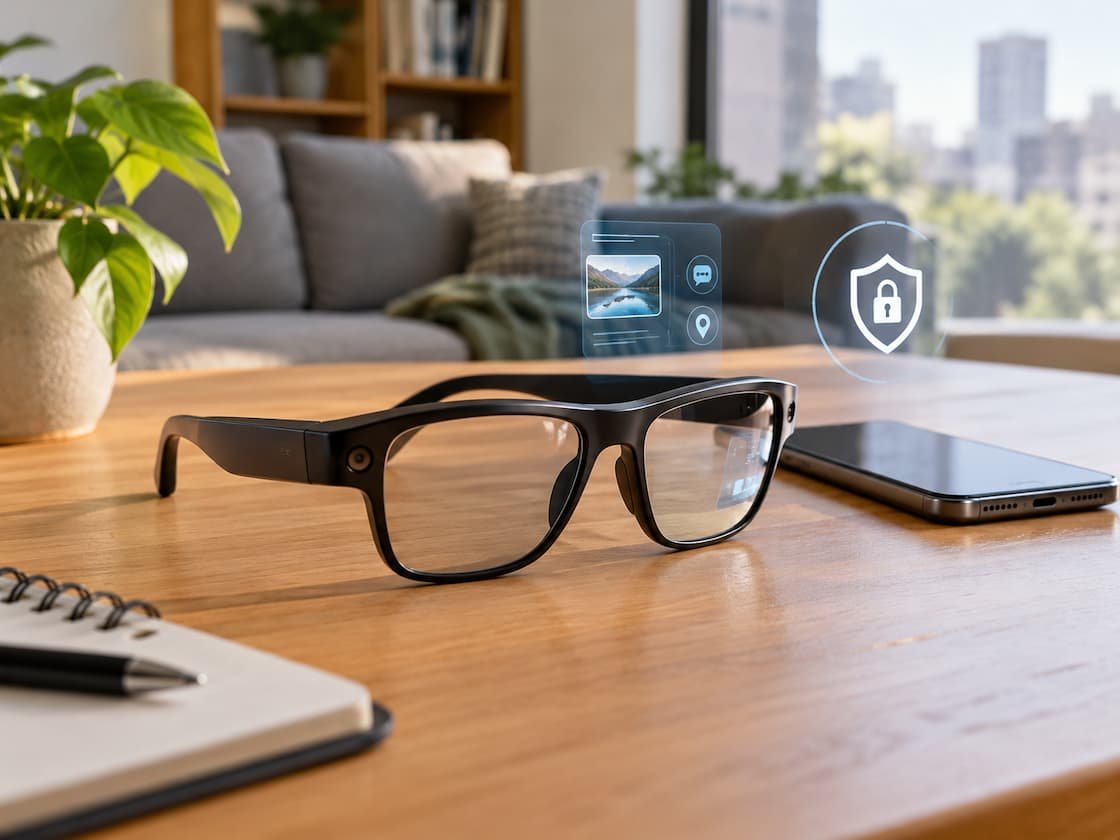
Smart glasses are moving beyond the role of hands-free cameras and wireless earbuds. In September 2026, the category is increasingly being built around AI systems that can interpret what the wearer sees and hears, answer questions about the surrounding environment, translate speech, provide navigation, summarize information, and eventually act on the wearer’s behalf. The change is visible across several competing platforms. Meta has expanded its AI-glasses lineup with Ray-Ban Meta Gen 3, Ray-Ban Meta Audio, new Meta Glasses models, and broader access to its display-equipped Ray-Ban Meta Display. Google is preparing Android XR audio glasses with Gemini, while display glasses are also part of its longer-term platform strategy.
At the same time, regulators and researchers are focusing on a problem that becomes harder as these devices become more useful: the person wearing the glasses is not the only person whose information can enter the system. A camera pointed at a scene can capture strangers. Microphones can hear conversations. AI systems can turn those raw inputs into descriptions, searchable memories, translations, or other derived information. And when processing moves between the glasses, a phone, and cloud infrastructure, the privacy question is no longer simply whether a camera is recording.
That is why the most important development in smart glasses in 2026 is not one particular camera, display, or AI feature. It is the transition from a wearable accessory into a continuously context-aware computing system—and the privacy architecture that has to accompany it.
The Hardware Is Becoming More Like a Computing Platform
The first generation of mainstream camera glasses was relatively straightforward. A camera captured photographs and video, microphones handled calls and voice commands, speakers provided audio, and a smartphone supplied much of the connectivity and processing. Modern AI glasses retain that architecture but add significantly more software intelligence.
Meta’s Ray-Ban Meta Gen 3, announced at Connect 2026, has a 12-megapixel camera, 3K Ultra HD video recording, a six-microphone array, and up to nine hours of battery life, according to Meta. The company says the microphone system can reduce more than 90% of background noise. The glasses also retain a front-facing capture LED intended to indicate when photographs or video are being recorded.
Google’s Android XR approach illustrates the same shift from isolated functions toward an environmental computing system. Google says its forthcoming intelligent eyewear can use Gemini to answer questions about what the wearer sees, provide navigation, translate speech and text, handle messages and calls, and interact with phone applications. Google describes two broad categories: audio glasses, which provide information through speakers, and display glasses, which can place information in the wearer’s field of view.
The distinction matters because a conventional camera records an event, while an AI assistant can interpret it. A photograph of a restaurant sign is one piece of data. A system that recognizes the restaurant, reads its menu, searches for reviews, and recommends an item has turned that image into a chain of computational actions. Likewise, a microphone recording a conversation is different from an AI system that transcribes it, summarizes it, and remembers information from it. That extra layer is where much of the new capability—and much of the new privacy sensitivity—comes from.
The AI Processing Problem Is Larger Than the Glasses
There is a physical limit to how much computing hardware can be placed inside an ordinary-looking pair of spectacles while keeping them light, cool, and comfortable. Meta acknowledges this constraint in its September 2026 engineering explanation of Private Processing. The company says simpler functions can occur directly on the glasses, while more advanced AI requires larger models that cannot practically fit within the device. Those workloads can therefore involve cloud infrastructure.
This creates a three-part data path:
Glasses → phone or network → cloud AI → response back to the wearer
The exact path depends on the feature, but the architecture has important consequences. A device that merely captures a photograph can keep the image locally until the user transfers it. A conversational AI feature may require some form of processing beyond the glasses themselves. Meta says its private processing system uses confidential virtual machines so that AI workloads involving personal context can be processed in protected cloud environments. The company says the system is designed so that Meta cannot access the data being processed inside those environments. That is a company-described security architecture, rather than independent proof that every privacy risk has disappeared.
This distinction is important because encryption, confidential computing, and local processing solve different problems. Local processing can reduce the amount of sensitive information leaving a device. Encryption can protect information while it moves or is stored. Confidential computing can restrict access to data while certain workloads are running. None of these automatically determines whether recording a bystander was appropriate in the first place.
The Capture LED Helps, but It Does Not Solve the Whole Problem
Camera indicators have become one of the most visible privacy mechanisms in smart glasses. Meta says its AI glasses use a white capture LED that blinks when content is being captured for the user’s gallery. On its second-generation glasses, Meta says the camera is disabled when the system detects that the LED has been blocked, and it is also adding safeguards against physical tampering with the LED. That is a meaningful engineering choice because it attempts to make the privacy signal technically enforceable rather than merely cosmetic. But it also reveals the difficulty of the problem.
The LED primarily communicates that the camera is actively capturing. It does not necessarily explain what an AI system is doing with the information, whether audio is being processed, whether information is temporarily cached, or whether an AI response incorporates previously collected context.
The distinction becomes more important as glasses become more proactive. A camera that records only after a clearly visible button press is easier for surrounding people to understand. A device designed to answer questions about the environment, remember details, or provide continuous assistance creates more complicated expectations about when sensing begins, what gets retained, and who can ultimately access the resulting information.
Researchers are already working on alternatives to the conventional model. A 2026 IEEE PerCom paper described SITARA, a prototype privacy architecture that applies face blurring on the device, supports synthetic face replacement, and uses consent-based mechanisms for restoring protected visual information. The researchers argue that privacy should be addressed at the point of capture rather than relying entirely on later cloud processing. Another 2026 CHI study examined an opt-in privacy model with 18 participants. The researchers reported that bystanders strongly supported stronger privacy protections, while wearers appreciated safeguards but found some of them cumbersome. That tension is significant: a privacy system can be technically effective and still be difficult enough to use that people avoid it.
Privacy Is Becoming a Bystander Problem
Traditional smartphone photography already creates privacy questions, but smart glasses change the social context. A phone normally has to be raised, aimed, and operated. Glasses sit on the user’s face and can capture from approximately the same viewpoint throughout the day. That makes recording less conspicuous and potentially more continuous. France’s data-protection authority CNIL explicitly identified this issue in June 2026. It described smart glasses as devices combining cameras and microphones with smartphones and AI systems capable of answering questions about the wearer’s surroundings. CNIL also launched an action plan around the privacy implications of the technology. In a January 2026 survey of 2,128 adults representing the French population, 67% said smart glasses posed a risk to people’s privacy.
Australia’s eSafety Commissioner likewise published guidance in August 2026 discussing covert recording and potential harms involving image-based abuse, cyberbullying, and other misuse. The UK’s Information Commissioner’s Office has taken a more nuanced position. In September, ICO Chief Executive Paul Arnold wrote that smart glasses can provide substantial benefits, including helping visually impaired people understand surroundings and navigate more independently, while also creating serious privacy and safety concerns when used irresponsibly.
The issue, therefore, is not simply whether smart glasses are “private” or “not private.” Different uses create different risks.
A device assisting a visually impaired person with navigation is not equivalent to a device secretly recording people. A user deliberately photographing a landmark is different from continuous recording in a changing social environment. A local AI model answering a question is different from a cloud service retaining a detailed history of interactions. The technology increasingly needs to account for those distinctions.
The Industry Is Splitting Into Different Technical Approaches
By September 2026, smart glasses are no longer following one single hardware model.
| Approach | What the wearer gets | Main technical characteristic |
|---|---|---|
| Audio AI glasses | Voice assistant, calls, translation, and environmental help | Cameras/mics plus open-ear audio, without a visual display |
| Camera AI glasses | Hands-free photos, video, and visual AI | Camera and microphones connected to phone/cloud AI |
| Display AI glasses. | Information visible in the wearer’s field of view | Sensors plus an optical display |
| Privacy-focused alternatives | Reduced recording or stronger user control | Camera-free or more explicitly user-activated designs |
Meta’s September 2026 portfolio now spans several of these categories. Ray-Ban Meta Audio focuses on audio and AI without a display, while Ray-Ban Meta Gen 3 adds improved camera, microphone, and battery capabilities. Meta’s Ray-Ban Display adds visual information, navigation, and other on-glasses experiences. Google is pursuing a comparable platform strategy through Android XR, with audio glasses arriving first and display glasses remaining part of the platform’s planned ecosystem. The competition is consequently moving beyond “which glasses have the best camera?” The deeper question is how much sensing, processing, storage, and interaction each platform puts into the device and its surrounding cloud ecosystem.
More Capable Glasses Also Create More Data
Video is particularly important because improved cameras and longer recording capability can generate substantial amounts of information. Higher resolution increases the amount of data associated with captured media, while spatial audio can add another layer. Meta says its AI glasses will support Dolby Atmos capture for spatial-sound video later in 2026. For readers trying to understand the difference between storage capacity and the amount of data generated by media, the TechTalksX Data Storage Unit Converter can be useful when comparing KB, MB, GB, and larger storage measurements.
But raw file size is only part of the story. AI systems can extract information from media without retaining the original media indefinitely. A photograph can produce recognized text, an object label, a location estimate, or an identity-related inference. A conversation can become a transcript or summary. In other words, privacy has to account not only for files but also for information derived from those files.
That is one reason researchers are looking beyond face blurring alone. A September 2026 research paper called MIRAGE argues that conventional face anonymization may not be sufficient because people can potentially be re-identified from gait, posture, and body silhouette. Its prototype applies full-body privacy techniques rather than concentrating only on faces. The research is still experimental, but it illustrates how quickly the privacy problem expands once cameras become persistent sensing devices.
Regulators Are Applying Existing Rules Rather Than Waiting for a New “Smart Glasses Law”
Governments are not uniformly responding by attempting to ban the technology. In the UK, a September 2026 parliamentary answer stated that existing data-protection legislation applies to connected and AI-enabled devices such as smart glasses. The government also said there were no current plans to ban camera-equipped smart glasses. Another UK parliamentary response concerning schools emphasized transparency, privacy, and the recording of personal data, particularly where children are involved, while pointing to existing data protection and safeguarding principles.
This approach reflects an important regulatory reality: the same camera can be used in very different circumstances. The legal question can therefore depend on who is collecting information, why it is being collected, whether people are identifiable, where the recording occurs, how the information is processed, and what happens to it afterward. That makes privacy-by-design increasingly important because relying exclusively on users or individual organizations to interpret complex rules after the fact can leave a large gap between technical capability and practical control.
What Has Actually Changed in 2026?
The most concrete change is the combination of several capabilities that previously existed separately.
Confirmed developments include:
- Meta’s Ray-Ban Meta Gen 3 has a 12MP camera, 3K video, a six-microphone array, and up to nine hours of battery life.
- Meta has expanded its AI-glasses portfolio with audio-only models, additional frame styles, and broader international availability.
- Meta is bringing its Muse personal AI agent to AI glasses.
- Meta is expanding Ray-Ban Display with navigation, hologram-based calls, spatial-audio capture, and additional markets.
- Google is preparing Android XR intelligent eyewear with Gemini-based assistance, including audio glasses and planned display glasses.
- Privacy research is increasingly exploring on-device anonymization and consent mechanisms rather than treating privacy as a post-processing problem.
- European and UK regulators are publicly examining the privacy and safety implications of camera-enabled AI wearables.
What remains less certain is how these systems will behave at a large scale, particularly when AI glasses are used throughout an ordinary day rather than in carefully controlled demonstrations.
The Questions That Have Not Been Settled
Several issues remain open.
- How much information should glasses remember? A genuinely useful assistant may need persistent context. But the longer the history becomes, the more sensitive the resulting profile can become.
- How should bystanders give meaningful consent? A blinking LED provides a signal, but consent is more complicated than knowing that a camera is active.
- Which processing should happen locally? Local AI reduces some cloud exposure, but powerful multimodal models can demand considerably more computing resources than a lightweight wearable can comfortably provide.
- What happens when the AI is wrong? A system interpreting everything around the wearer can misidentify people, objects, signs, or conversations. As the glasses become more proactive, errors can have consequences beyond an incorrect chatbot answer.
- How will workplaces, schools, and private venues respond? Existing privacy and safeguarding rules may apply, but organizations still have to decide whether camera-enabled glasses are appropriate in specific environments.
These questions are not theoretical. The CNIL, ICO, and other regulators are already treating smart glasses as a technology requiring closer attention, while researchers are developing privacy architectures specifically because existing approaches do not fully address the problem.
The Bigger Change Is the Relationship Between the Device and Its Surroundings
Smart glasses are becoming more capable because several technologies have matured at the same time: compact cameras and microphones, efficient wearable processors, wireless connectivity, multimodal AI models, cloud inference, and increasingly practical optical displays. That combination turns eyewear into a first-person computing platform. The glasses can see approximately what the wearer sees, hear what the wearer hears, understand requests, and increasingly provide information without requiring a phone to be pulled from a pocket. Google’s Android XR plans and Meta’s 2026 product expansion show that multiple major platforms are pursuing this direction.
But the same architecture changes the privacy equation. The system does not exist only for the wearer. It observes an environment containing other people, private conversations, documents, screens, homes, workplaces, and public spaces.
As of September 27, 2026, the hardware and AI capabilities are clearly advancing, and companies are adding technical safeguards such as capture indicators, tamper detection, confidential processing, and user controls. Researchers and regulators are simultaneously pushing the discussion toward consent, on-device protection, and accountability. What has not yet been resolved is whether those mechanisms can keep pace with devices that increasingly understand and remember the world around their wearer. The next stage of smart glasses will therefore be defined not only by what the glasses can see and do, but also by how clearly the technology communicates what it is sensing, where that information goes, how long it remains available, and what control people around the wearer actually have.