
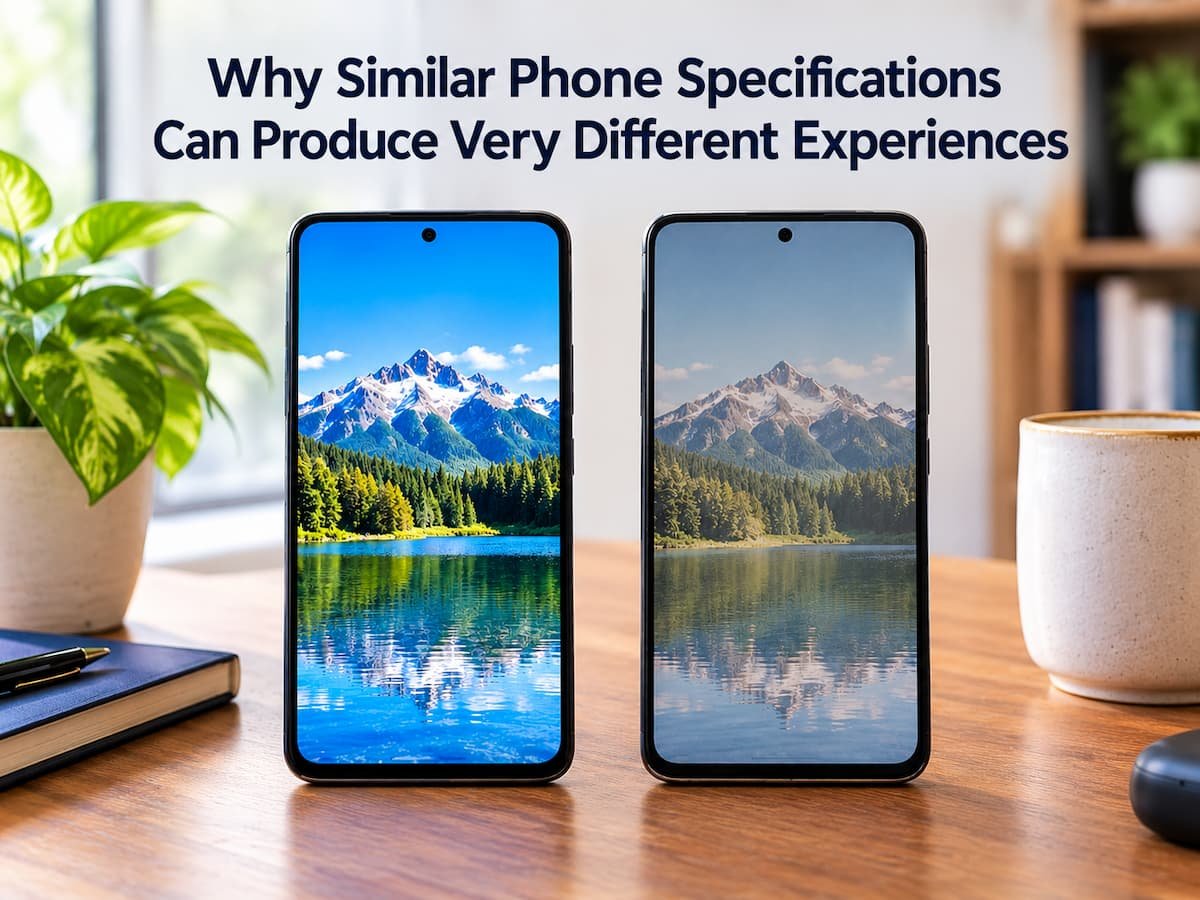
A phone specification sheet creates the impression that smartphones can be compared like spreadsheets. One model has 12GB of RAM; another has 12GB. Both have 50MP main cameras, 5,000mAh batteries, 120Hz OLED displays, and eight-core processors. On paper, they appear remarkably close.
Then you use them. One phone may feel consistently responsive, take better photographs at night, remain cool during a long gaming session, and last comfortably through the day. The other may have almost identical headline specifications but feel less consistent, process photographs differently, become warm under sustained load, or drain its battery faster.
That is not necessarily because one manufacturer is lying about the specifications. The more important problem is that a specification describes a component or capability, while the experience is produced by the entire system.
A 5,000mAh battery does not tell you how efficiently the phone uses that energy. A 50MP camera does not describe the sensor’s size or image processing. Twelve gigabytes of RAM does not tell you how aggressively the operating system keeps applications in memory. Even the same processor can behave differently when placed inside two phones with different cooling systems and power limits. The specification sheet is therefore a starting point. It is not the finished description of the phone.
Start With the Parts the Specification Sheet Leaves Out
The easiest way to understand this is to imagine two phones built around the same central chip. The processor manufacturer can define the capabilities of the SoC, but the phone manufacturer determines much of the environment in which that chip operates. Cooling, battery capacity, firmware, software scheduling, memory configuration, and power-management behavior all influence what happens after the processor starts working.
This is particularly visible during sustained workloads. A processor can deliver high performance for a short burst and then reduce its operating speed as temperature rises. The physical design of the phone determines how effectively heat can be moved away from the chip.
Recent independent testing illustrates the point. Ars Technica found that Google’s Pixel 11 series could retain much of its performance during extended workloads, while its GPU remained less capable than competing high-end chips in graphics-heavy games. The same review also noted that the Galaxy S26 could feel inconsistent despite strong headline performance. That is why two phones using processors from the same performance class can have different personalities. One may prioritize sustained performance, another battery life, and another lower surface temperature. The chip name tells you what silicon is available. The phone determines how that silicon is used.
The Camera Megapixel Trap
Camera specifications are among the clearest examples of why numbers can be misleading. A 50MP camera has a 50-megapixel sensor output, but that number says relatively little about the final photograph. Sensor size, individual pixel characteristics, lens quality, aperture, stabilization, autofocus hardware, and image-processing algorithms can all influence the result.
The processor matters here too because modern smartphone photography is heavily computational. Qualcomm’s camera platforms, for example, include image signal processors designed for functions such as noise reduction, autofocus, and electronic image stabilization.
Imagine two phones with 50MP main cameras. One could use a larger sensor, better optics, and more sophisticated computational processing. The other might use a smaller sensor with a different lens and simpler processing. The specification sheet gives both cameras the same headline resolution, but the cameras are not equivalent systems.
Night photography makes the difference particularly obvious. A phone has to gather enough light, stabilize the exposure, reduce noise, and combine or process image data without destroying fine detail. None of those characteristics is represented by “50MP.”
The same issue appears with Zoom. A phone advertising 3× optical zoom and another advertising 3× zoom may still produce different results because the sensors, lenses, stabilization, and processing pipelines differ. Digital cropping can also be presented alongside optical or sensor-based zoom capabilities, making the raw zoom number insufficient for judging image quality.
Megapixels describe resolution. They do not describe photographic quality.
RAM Is Capacity, Not a Promise of Multitasking
RAM is another specification that looks straightforward until software enters the equation. If two phones have 12GB of RAM, they have the same nominal memory capacity. That does not mean they will keep the same number of applications ready in the background.
The operating system decides how memory is allocated. Manufacturers can also tune background activity, application restrictions, and memory management differently. An aggressive memory-management policy may close background applications sooner in order to reduce power consumption, while another configuration may keep more applications available at the expense of additional memory and potentially battery use.
This is why “12GB RAM” should not be interpreted as “these phones will multitask identically.” Memory type and speed can matter too, but even those specifications do not completely describe the experience. The processor’s memory controller, storage system, operating-system behavior, and software workload all interact with RAM.
There is also an important distinction between having enough RAM and having more RAM than you need. Once a phone has sufficient memory for the applications and multitasking pattern of a particular user, adding several additional gigabytes does not necessarily create a proportionate improvement in everyday responsiveness. The more useful question is not simply “How much RAM does it have?” It is:
How does this phone manage the RAM it has?
Storage Can Make Two “256GB” Phones Feel Different
Storage capacity is another deceptively simple specification. Two phones may both offer 256GB of storage while using different storage technologies, controllers, or file-management configurations. Storage speed can affect application installation, large file transfers, and some loading operations.
Qualcomm, for example, lists UFS 3.1 support as part of the feature set on some of its mobile platforms. But a platform’s support for a particular storage standard does not mean every phone using that platform will necessarily implement identical storage hardware. There is also the question of how much storage is actually available to the user. The operating system and preinstalled software occupy part of the advertised capacity. For ordinary browsing and messaging, the difference between storage implementations may barely matter. Large games, media-heavy workflows, and frequent file transfers can expose it more clearly.
Storage therefore has at least three separate questions:
- How much capacity is provided?
- What storage technology is being used?
- How has the manufacturer implemented it in the finished device?
The number printed on the box answers only the first.
Battery Capacity Is Not Battery Life
Perhaps the most misunderstood phone specification is battery capacity. A 5,000mAh battery contains a certain amount of electrical charge capacity. It does not guarantee a particular number of hours of use. Battery life depends on the entire phone. The processor, display, modem, cameras, background software, operating system, network conditions, brightness, and application workload all consume energy differently.
Display technology is especially important. A 6.7-inch 120Hz OLED panel and a 6.1-inch 60Hz OLED panel do not necessarily consume the same amount of power simply because both are OLED. Brightness, resolution, refresh behavior, display driver efficiency, and adaptive refresh technology can all change consumption.
Google’s current Pixel specifications illustrate how much information sits behind a simple battery figure. The Pixel 11 Pro XL lists a typical 5,115mAh battery alongside a 6.8-inch 1344×2992 LTPO OLED display with a 1–120Hz variable refresh range. The smaller Pixel 11 uses a typical 4,985mAh battery and a 60–120Hz OLED display. Comparing the batteries without considering those displays would leave out a significant part of the equation. Network use adds another variable. A phone sitting on a strong Wi-Fi connection may consume power differently from the same phone constantly searching for or maintaining a weak cellular connection.
This is why battery capacity is useful for understanding hardware, while battery testing is needed to understand endurance.
The Display Specification Is More Than “120Hz AMOLED”
Two phones can both advertise 120Hz OLED displays and still look noticeably different. Resolution determines pixel density. Brightness affects outdoor visibility. Contrast affects perceived depth. Color calibration affects accuracy. The panel’s refresh technology affects motion and power consumption. The way 120Hz is implemented matters as well.
Some displays can dynamically move between low and high refresh rates depending on what is happening on screen. Others may have fewer operating states. A display that can drop to a very low refresh rate for static content may have different power characteristics from one that remains at a relatively high refresh rate.
Google’s Pixel 11 Pro XL, for example, specifies an LTPO OLED panel capable of 1–120Hz, while the standard Pixel 11 specifies a 60–120Hz range. Both are described as Smooth Display, but their refresh behavior is not identical. Brightness ratings also require caution. A manufacturer’s peak brightness figure may describe a particular test condition rather than sustained full-screen brightness in every situation. So when two phones both say “120Hz OLED,” look beyond the headline. Ask about resolution, adaptive refresh, brightness behavior, panel quality, and calibration.
The Same Processor Does Not Mean the Same Performance
The processor is probably the specification people trust most, and it is also one of the easiest to misunderstand. A Snapdragon, Dimensity, Tensor, or Apple chip represents a major part of the phone’s computing platform, but performance is affected by implementation. The cooling system is particularly important. A thin phone has less physical room for heat dissipation than a larger device. A manufacturer can also choose different power limits depending on its priorities.
The consequence is that short benchmark performance and sustained performance are not necessarily the same thing.
Ars Technica’s testing of the OnePlus 15, for example, found that its Snapdragon 8 Elite Gen 5 could operate at very high performance levels but still reduce performance under thermal load. The phone’s larger cooling system helped during extended gaming, but the device became noticeably hot under sustained stress. The lesson is not that thermal throttling is inherently bad. Reducing performance can be a deliberate way to control temperature and power consumption. The important point is that a benchmark score represents a particular test condition. It should not automatically be interpreted as the performance you will receive indefinitely during an hour of gaming, video processing, or another sustained workload.
Software Can Make Identical Hardware Feel Different
Two phones can have similar hardware and still feel different because software changes the way that hardware is presented to the user. Animation speed, background activity, notification handling, application management, touch behavior, and system services all contribute to perceived responsiveness. This is why benchmark results and subjective responsiveness do not always line up perfectly.
A phone can score highly in a benchmark while having animations that make it feel less immediate. Another can have lower peak benchmark performance but feel extremely responsive during common tasks because the software is well tuned for the hardware. Software optimization also affects cameras. Computational photography is effectively a pipeline: the sensor captures data, the ISP and other hardware process it, and software decides how that information should become a finished image.
Two 50MP cameras can therefore produce very different images without either camera failing to meet its advertised specification. The operating system also determines how long a phone remains useful. Update support, security patches, and application compatibility do not appear in RAM, camera, or processor specifications, yet they can matter more to long-term ownership than small hardware differences.
Modem Performance Is Another Hidden Variable
Smartphone users often compare processor specifications while overlooking the cellular modem. Two phones can have similar SoCs or even closely related platforms but behave differently on cellular networks because of modem configuration, supported frequency bands, antenna design, carrier aggregation, and regional variants.
Signal conditions also matter. A phone operating in a weak-signal environment may use considerably more power while maintaining connectivity. This creates an unusual situation where two phones with identical battery capacities can have different endurance for the same person simply because one receives a stronger signal in the places where that person normally uses it. Network specifications are therefore particularly difficult to evaluate from a product page. “5G supported” is only the beginning. The relevant bands and regional model are important too.
Even the Physical Design Changes the Experience
Specifications rarely describe ergonomics adequately. Weight, thickness, camera-bump design, frame shape, button placement, and material choices can change how comfortable a phone feels during several hours of use. A larger battery may provide greater capacity but require a thicker or heavier design. A larger camera sensor may improve photography while producing a larger camera module. More cooling hardware may help sustained performance but require additional internal space.
These are not flaws in the specification. They are consequences of engineering trade-offs. This is one reason a phone with seemingly superior individual specifications may not feel superior as a complete device. Improving one component often consumes physical space, energy, money, or weight that has to come from somewhere else.
A Useful Example: Three Phones With “The Same” Main Hardware
Imagine three phones with these headline specifications:
| Specification | Phone A | Phone B | Phone C |
|---|---|---|---|
| Processor class | High-end | High-end | High-end |
| RAM | 12GB | 12GB | 12GB |
| Storage | 256GB | 256GB | 256GB |
| Main camera | 50MP | 50MP | 50MP |
| Battery | 5,000mAh | 5,000mAh | 5,000mAh |
| Display | 120Hz OLED | 120Hz OLED | 120Hz OLED |
The table makes them look almost interchangeable. Now add the information normally hidden beneath those labels.
Phone A has a larger camera sensor, strong cooling, and aggressive performance tuning. Phone B uses a smaller camera sensor but sophisticated computational photography and conservative power management. Phone C has a bright, high-resolution display, a thin chassis, and lower sustained power limits.
Suddenly the three phones have different identities. Phone A may emphasize sustained performance. Phone B may emphasize photography and efficiency. Phone C may prioritize display quality and portability. None of those differences contradicts the original specification table.
The problem was that the table described the ingredients, not the recipe.
What Specifications Are Actually Worth Comparing?
Instead of collecting the largest numbers from a product page, separate the specifications into four groups.
1. Raw Hardware
Look at:
- SoC and CPU/GPU architecture
- RAM capacity and type
- Storage capacity and technology
- Display resolution and panel type
- Battery capacity
- Camera sensor and lens configuration
These tell you what the phone physically contains.
2. Implementation
Then investigate:
- Sustained performance
- Thermal behavior
- Display brightness and calibration
- Camera processing
- Charging behavior
- Modem and connectivity configuration
- Memory management
This is where phones with similar hardware often begin to diverge.
3. Software
Check:
- Operating-system version
- Update policy
- Background application management
- Camera software
- AI features
- Desktop or ecosystem integration
- Compatibility with the applications you actually use
Software determines how much of the hardware is exposed in everyday use.
4. Your Workload
Finally, ask what you actually do.
A person who mainly uses messaging, browsing, and video streaming may barely notice a difference in sustained CPU performance. A mobile gamer can notice thermal behavior much more quickly. A photographer may care more about sensor size and image processing than megapixels. Someone who travels frequently may care about modem bands, battery endurance, and charging speed. The specification that matters most is therefore often the one connected to your actual workload.
Why Review Results Can Disagree
It is also normal for reputable reviewers to reach somewhat different conclusions about the same phone. Battery tests can use different brightness levels, networks, applications, and test durations. Gaming tests can use different graphics settings and temperatures. Camera comparisons can involve different scenes and processing preferences. That does not automatically make one test wrong.
A benchmark is a measurement under defined conditions. Changing those conditions can change the result. This is particularly important when a manufacturer publishes its own performance figures. Manufacturer testing can be useful for understanding the company’s stated capability, but independent testing can reveal how that capability behaves in a complete retail device. The most useful reviews therefore explain the testing method instead of simply presenting a single number.
The Specifications That Can Mislead You Most
Some common numbers deserve extra skepticism when used alone:
- Megapixels: They describe image resolution, not the complete camera system.
- Battery capacity: It measures charge capacity, not guaranteed endurance.
- RAM: Capacity does not determine memory-management behavior.
- Peak CPU frequency: A maximum clock is not the same as sustained operating speed.
- Benchmark score: It represents a workload under particular test conditions.
- Refresh rate: A 120Hz panel does not mean every application or animation is operating at 120Hz.
- Charging wattage: Maximum input power does not guarantee a fixed charging time because charging behavior changes throughout the charging cycle.
- AI performance: A high AI-compute figure does not mean every AI application will run faster.
These specifications remain useful. The mistake is treating them as complete descriptions of the user experience.
A Better Mental Model for Comparing Phones
The easiest way to compare two similar phones is to stop asking whether their specifications match and instead ask where their specifications diverge in implementation. Start with the processor, but then investigate cooling and sustained performance. Check RAM, but also consider software memory management. Look at camera resolution, but examine the sensor, optics, and processing pipeline. Compare batteries, but consider the display, modem, and power-management behavior.
Then look at the parts that are difficult to express as headline numbers: software support, haptics, speakers, ergonomics, thermal comfort, and reliability. This approach also explains why manufacturers can legitimately advertise impressive numbers while two devices built around similar components provide very different experiences. The specifications are usually telling you something true; they simply are not telling you everything.
The Real Meaning of “Similar Specifications”
A specification sheet is most useful when it tells you what to investigate next. If two phones have the same battery capacity, look at display efficiency and independent endurance testing. If they use the same processor, look at cooling and sustained performance. If both have 50MP cameras, examine sensor size, lenses, and computational photography. If both advertise 120 Hz displays, check resolution, adaptive refresh behavior, and brightness.
The closer two phones look on paper, the more important these second-level details become. That is ultimately why similar specifications can produce very different experiences. Smartphones are not collections of independent numbers. They are integrated systems in which the processor affects the camera, the display affects battery life, the cooling system affects sustained performance, the software affects memory use, and the physical design constrains what engineers can do with all of those components.
The useful comparison is therefore not the phone with the larger collection of impressive numbers. It is the phone whose hardware, software, and engineering choices fit the way you actually use a phone.