
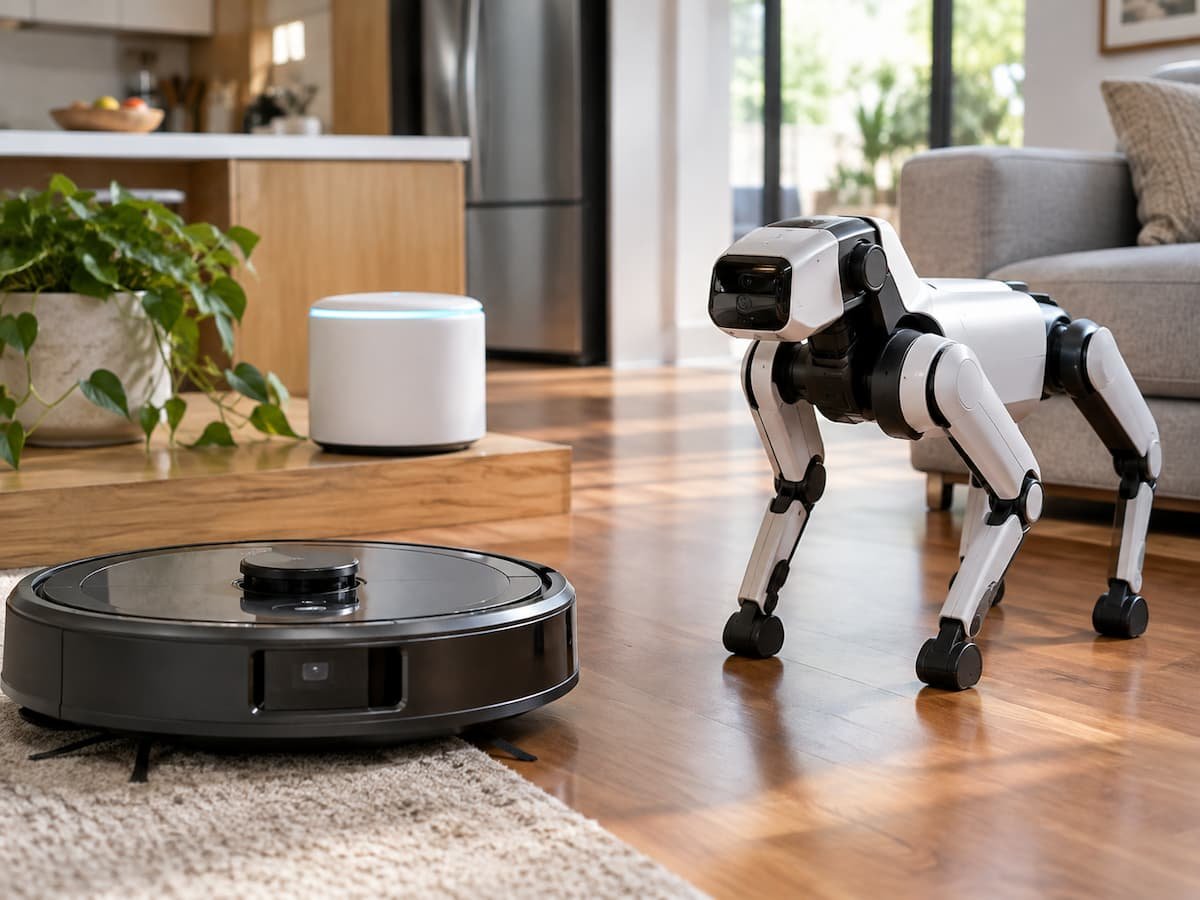
Artificial intelligence has spent most of its modern history operating through digital interfaces. A user types a request, a model processes information, and software returns an answer. Even when the underlying system is highly capable, the interaction usually ends at a screen, speaker, or other digital output. Physical AI changes where that process ends. Instead of stopping after generating text, an image, or a recommendation, a physical-AI system can use its output to influence something in the real world. A robot can move an object. An autonomous vehicle can change direction. A warehouse machine can identify a package and reposition it. An industrial system can inspect a component and decide what should happen next.
This is not one new product category. It is an emerging way of building intelligent machines by combining AI models with sensors, robotics hardware, simulation, and real-time control. The technology is developing quickly in 2026, but the important story is not that humanoid robots are suddenly becoming household workers. The more significant development is that AI models are increasingly being trained to deal with physical environments, where mistakes have consequences and where information cannot be represented entirely as text or images.
Why Physical AI Requires a Different Kind of Intelligence
A screen-based AI system can often operate in a relatively forgiving environment. If a chatbot misunderstands a question, the user can clarify it. If an image generator produces the wrong object, another image can be requested. A machine interacting with the physical world does not have that luxury.
Consider a robot instructed to place a glass on a table. It needs to identify the glass, distinguish it from nearby objects, estimate its position and orientation, determine how to grasp it, move its arm along an appropriate path, control the force of the gripper, and release the object without knocking it over. Then something unexpected can happen. The glass may be closer to the edge than expected. Another object may block the robot’s path. A person may walk into the workspace. The object may be heavier, lighter, or more slippery than the training examples suggested.
The AI therefore needs more than recognition. It needs a continuous relationship between perception, reasoning, and action. That is why robotics researchers increasingly describe these systems as vision-language-action models or embodied models. Google DeepMind’s Gemini Robotics work, for example, is designed to connect multimodal reasoning with physical robot actions rather than treating visual understanding and robot control as completely separate problems.
The resulting architecture resembles a feedback loop rather than a traditional software request:
Sensors → perception → reasoning → action → new sensor information → adjustment
The machine acts, observes the result, and updates what it does next. That feedback loop is one of the defining differences between physical AI and conventional generative AI.
The Big Technical Change Is Generalization
Robotics itself is not new. Factories have used programmable robotic arms for decades. The limitation of many traditional systems is that they work extremely well within carefully defined conditions. A machine may repeatedly pick up the same component from approximately the same position, perform a known operation, and place it in a known location. Changing the product or environment can require substantial reprogramming.
Physical AI is attempting to reduce that dependence on manually specifying every behavior. Rather than programming a robot with a long sequence of fixed instructions, developers can train models to learn relationships between what a robot sees, what it is asked to accomplish, and what movements are appropriate. This does not make robots universally capable. Generalization remains one of the hardest problems in robotics. But it changes the development objective. The question becomes less about teaching a machine one exact movement and more about teaching it a transferable skill.
Google’s Gemini Robotics 2 work demonstrates this direction. The company says its models can reason across longer sequences and support whole-body behaviors, allowing a humanoid robot to combine locomotion with manipulation instead of treating walking and object handling as completely independent activities.
That distinction matters because real-world tasks rarely consist of one isolated action. A warehouse robot may need to navigate to a shelf, locate a package, reach around another object, pick up the package, transport it, and place it somewhere else. A household robot would face even more variation. The more steps a task contains, the more important planning and error recovery become.
Simulation Is Becoming a Second Training Ground
There is an obvious problem with teaching machines through physical trial and error: the real world is expensive. A robot can only perform so many experiments before its batteries need charging, components require maintenance, or something breaks. Setting up thousands of variations of a warehouse or factory is impractical. Simulation provides another option.
Robotics developers can create virtual environments in which machines practice navigation, manipulation, and other behaviors. Millions of simulated interactions can potentially be generated much faster than equivalent physical experiments. NVIDIA has made simulation and synthetic-data generation a major part of its physical-AI platform. Its robotics technologies include tools for developing digital environments, generating training data, and testing robot behavior before deployment on physical machines.
The advantage is obvious, but simulation creates its own problem. A simulated environment is only useful if it represents the real world closely enough. Real objects bend. Floors have different levels of friction. Lighting changes. Sensors produce noise. Humans move unpredictably. Mechanical components wear down. A virtual robot can behave perfectly under simulated conditions while failing when one small physical assumption turns out to be wrong. This is why researchers use a combination of simulation and real-world data rather than assuming simulation alone will solve the training problem.
Physical Data Is Becoming a Valuable Resource
The AI industry has spent years discussing the availability of digital training data. Robotics introduces a different shortage. There is far less high-quality data describing how physical objects should be manipulated across thousands of environments. A video showing a person opening a drawer contains useful information, but a robot needs more than the visual sequence. It needs information about movement, position, force, timing, and the relationship between its own actions and the resulting physical changes.
This makes demonstrations valuable. Researchers and companies are exploring systems in which humans demonstrate tasks and robots learn from those demonstrations. Other approaches combine recorded robot trajectories, synthetic data, and simulations. NVIDIA reported in September 2026 that Skild AI’s S1 model can use a single video demonstration to learn previously unseen long-horizon tasks through in-context learning rather than requiring conventional task-specific retraining.
If techniques like this prove reliable at scale, they could change the economics of robot training. Instead of a developer manually programming a robot every time a new task appears, a worker could potentially demonstrate the task and allow the model to adapt. That possibility is significant, but it should not be confused with a solved problem. A robot learning a task from one demonstration must still execute it safely and repeatedly under different conditions. Reliability is a much higher bar than demonstration.
Why Humanoid Robots Keep Appearing
Humanoid robots are receiving disproportionate attention because their body shape has an obvious practical argument behind it. Human environments were designed around human bodies. Doors have handles at particular heights. Shelves occupy human-accessible positions. Stairs have dimensions intended for human feet. Tools, workstations, and storage systems are generally built around human reach.
A humanoid robot could theoretically operate within these environments without requiring companies to rebuild everything around a specialized machine. That does not mean humanoids are automatically the most efficient robot design. A wheeled machine may be better for moving goods across a warehouse. A robotic arm may be better for repetitive manufacturing. A specialized agricultural machine may be better suited to a particular crop.
Physical AI is therefore broader than humanoid robotics. The intelligence can be placed inside many different mechanical forms. This distinction is important because public discussions often treat “physical AI” and “humanoid robots” as synonyms. They are not. Physical AI describes the intelligence and control approach. A humanoid is one possible physical platform for using it.
The First Commercial Environments Are Relatively Predictable
The earliest serious deployments are happening where companies can constrain the problem. Factories and warehouses provide defined workspaces, repeatable processes, and measurable objectives. They also allow organizations to introduce safety boundaries and monitor robot performance.
The International Federation of Robotics reported around 7,000 humanoid robots sold globally during 2025, although that figure remains tiny compared with the established industrial-robot market. Reuters reported that many early humanoid deployments are still related to research and development rather than mature, large-scale production.
This is an important distinction when evaluating the industry’s progress. A robot operating successfully in a factory pilot demonstrates that a particular combination of hardware and software can perform a task under specified conditions. It does not demonstrate that the same system can perform arbitrary household work. Industrial environments can be engineered around the machine. Homes cannot be controlled nearly as easily. A factory can establish where robots move. A home contains pets, children, furniture, stairs, fragile objects, irregular surfaces, and constantly changing layouts. That makes domestic robotics a much harder problem.
The Cloud Cannot Do Everything
Another important change is happening in the computing architecture behind these machines. Large AI models generally require substantial computing resources. Physical machines, however, often need decisions with low latency. If a robotic arm needs to stop because a person unexpectedly enters its path, waiting for a distant cloud server to interpret the situation may introduce unacceptable delay.
This creates a division of labor. Large models can be trained and updated using data center infrastructure, while smaller or optimized models can perform some inference locally on the robot. Google has developed Gemini Robotics On-Device specifically to bring robotics intelligence closer to the machine. The company says its local approach can operate without relying on continuous cloud connectivity and is intended to reduce latency for robotic applications.
The result is a computing architecture that looks increasingly like this:
Data center training → simulation → model optimization → local inference → physical control
That architecture has implications for processors, memory, networking, and power consumption. A robot needs enough local computing capability to interpret sensors and make decisions while also keeping energy use under control. More computing can improve capability but adds heat, weight, power consumption, and hardware cost. Physical AI therefore puts pressure on the entire computing stack rather than just the AI model.
Safety Has Become Part of the Intelligence Problem
When AI produces text, safety can often be handled through filtering, moderation, and user review. When AI controls machinery, safety must exist at multiple levels.
A robot should not rely on a language model alone to decide whether it is safe to move a heavy object near a person. Mechanical limits, emergency stops, collision detection, restricted operating zones, and conventional control systems remain important. NVIDIA’s 2026 work on physical-AI safety emphasizes this layered approach, treating safety as a combination of AI behavior, software, hardware, and the surrounding operating environment.
Google has similarly described safety mechanisms around its robotics models, including stopping behavior and mechanisms for responding when people are detected in potentially unsafe situations. The deeper issue is that physical AI has to deal with uncertainty.
A robot may be unsure what an object is. It may be uncertain about where a person will move. It may misinterpret an instruction. A useful physical-AI system therefore needs mechanisms for recognizing uncertainty rather than blindly acting on every prediction. That is one reason benchmarks for embodied AI are beginning to examine whether models can refuse unsafe actions or request human assistance when appropriate.
Networking and Data Movement Also Matter
Physical AI does not eliminate the network. In many systems, it makes networking more important. Robots may exchange sensor data, receive model updates, communicate with fleet-management systems, or send information to cloud infrastructure. Autonomous machines can also need reliable connections to coordinate with other systems. Latency becomes particularly important for time-sensitive operations, while bandwidth matters when large amounts of camera or sensor data are transferred.
The TechTalksX Wi-Fi Standard Explorer provides a useful reference for understanding the differences between modern Wi-Fi generations, while the Internet Network Ports Reference explains common networking services and communication concepts.
These are not specifically robotics tools, but they help explain an often-overlooked part of connected physical systems: intelligent machines still depend on ordinary networking infrastructure even when their final decisions happen locally.
What Could Slow the Industry Down?
The biggest obstacles are not necessarily model size. Hardware remains expensive. Batteries limit operating time. Motors and mechanical components require maintenance. Training data is difficult to obtain. Simulation does not perfectly reproduce reality. And safe deployment requires extensive testing. There is also an economic question. A company does not buy a robot simply because the robot can perform a task. The system has to justify its purchase through productivity, reliability, operating cost, and maintenance requirements.
For industrial deployments, that calculation can be relatively straightforward because a machine performs a measurable task repeatedly. For general-purpose robots, the calculation is more complicated. A robot that can perform 20 different tasks but requires frequent supervision may be less useful than a cheaper machine that performs three tasks with near-perfect reliability. That is why the industry’s most meaningful progress may come from narrow deployments before truly general-purpose machines become practical.
The Difference Between a Demonstration and a Deployment
The public has now seen robots walk, manipulate objects, fold items, sort materials, and perform other tasks using increasingly sophisticated AI systems. Those demonstrations provide evidence that the underlying technology works under particular conditions. They do not establish how the system performs after thousands of operating hours. That distinction will become increasingly important as physical AI moves from research laboratories into factories and commercial facilities.
A useful evaluation needs to consider more than whether the robot completes the task. It should also consider:
- how often the robot fails;
- how quickly it recovers;
- how much human supervision is required;
- how much energy it consumes;
- what maintenance it needs;
- how safely it behaves around people;
- and whether the overall system is economically competitive.
These measurements are considerably harder to achieve than producing an impressive demonstration video.
Where the Technology Stands in 2026
As of September 27, 2026, the physical-AI field has clearly progressed beyond the idea of simply putting a chatbot inside a robot. Major technology companies are developing models that connect visual and language understanding with robot actions. Simulation is being used to produce training environments and synthetic data. Smaller models are being optimized for local execution. Humanoid robots are beginning to enter industrial testing, while other forms of autonomous machinery are adopting similar AI techniques.
But the evidence still points to an industry in development rather than a finished general-purpose robotics market. The most credible near-term progress is likely to come from environments where tasks can be measured, data can be collected, and operating conditions can be controlled. More unpredictable applications will require improvements in perception, manipulation, reasoning, hardware reliability, and safety.
The Important Shift Is Not the Robot’s Shape
The most consequential part of physical AI may ultimately have little to do with whether robots look human. The larger change is that AI is acquiring a pathway from understanding information to changing the physical environment. That requires new training methods, new computing architectures, new safety mechanisms, and new ways of collecting data. It also changes what counts as a successful AI system. Producing a convincing answer is no longer enough when the system has to perform an action and deal with whatever happens afterward.
As of September 2026, that transition is underway, but many of its hardest problems remain open. Physical AI has demonstrated increasingly capable perception, planning, and control, yet reliability outside controlled environments remains a major challenge.
What is already changing is the boundary of AI itself. Intelligence is no longer being developed exclusively for applications that end on a screen. Increasingly, AI systems are being built to observe the physical world, make decisions within it, and act on those decisions. How far that capability can scale will depend less on demonstrations and more on whether the technology can become dependable, affordable, and safe in everyday operation.